
LEARN
What are akaushi?
A National Treasure from Japan
The Emperor's Breed
For years, I had requests for Wagyu genetics. While the quality of the Wagyu beef I had been around was excellent, I was not particularly impressed with the lack of growth and muscle in the Black Wagyu cattle. Then, in 2018, a local hay farmer hired me for a day to help him sort through a set of Akaushi cattle from Paul Marchant in Oakley, ID. I remember arriving and seeing a pretty impressive set of feeder calves. Assuming these were not the Japanese cattle we were there to see, I asked Paul, "Where are your Japanese cattle?" "Those are them!" he replied. That was the lightbulb moment for me! Akaushi are cattle that can produce the elevated quality of beef that Wagyu are famous for, while maintaining more growth and muscle than their Black Wagyu counterparts.
The term "Wagyu" literally means "Japanese cow." The Black Wagyu and Akaushi (or Red Wagyu) are two separate and distinct breeds. While both breeds come from Japan and produce extremely high quality beef, the similarities end there. The Japanese Brown or Akaushi (which literally translates to "red cow" in Japanese) originated in Kumamoto, Japan, where it is known as the Emperor's Breed.
Two Akaushi bulls, Rueshaw and Judo, were exported from Japan in 1976. The only Akaushi females to leave Japan were exported in 1994. In total, only 13 females and 6 males ever left Japan before they were declared a national treasure. At this point, you'd have better luck caging and shipping bald eagles than getting fresh Akaushi genetics from Japan. With so few animals to build from, it is important to make use of all of the original import lines to maintain as much genetic breadth as possible. All of the sire lines and maternal lines that ever left Japan are represented here at Christensen Genetics. You can see some of their descendants below.
sire lines

RUESHAW is the only national champion to ever leave Japan. Imported in 1976, his semen has sold for up to $22,000 for a single straw. CGX Genesis 3357L (pictured here) is a Rueshaw x Judo x Rueshaw x Akiko stud bull.
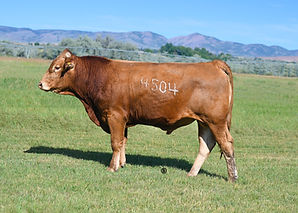
BIG AL is one of the most highly regarded of the original import sires. Arriving in utero with his mother Akiko in 1994, Big Al was the first Akaushi bull born on American soil in 1995. His son, CGX Little Al 4504M is pictured here.

SHIGEMARU is one of the most broadly used of the original import sires due to his ability to sire thick, stout, eye appealing cattle. His son, CGX Shoshone 3372L, is pictured here.

JUDO (pictured here) is the other Red Wagyu bull imported in 1976, providing a rare and valuable outcross for the breed. Judo semen has sold for up to $10,000 for a single straw.

HIKARI is a 1994 import who is a paternal brother to Big Al. He has sired breed legends Umemaru, Kotsukari, and H0518E, as well as CG Polled Hikari 2114, pictured here.

TAMAMARU is the original import sire best known for adding frame, length, and size to his offspring.
maternal lines
You can get most semen for $1k or less, whereas most true donors are $20k+. The value is in the mitochondrial DNA contributed ONLY by the bottom side of the pedigree.

KAEDEMARU was originally exported from Japan to Canada carried by her dam, Namiaki Ni. Her clone, STG Kaedemaru 001D is the mellowest, thickest, stoutest, heaviest muscled, and highest marbling of all of the females at Christensen Genetics.

HOMARE maternal line females are well known for adding size, stretch, growth and performance to their calves. Our $284,000 producing JC Ms Rueshaw 121 is a great example of this as she has weaned a 700 lb calf and is the granddam of our 738 lb weaning weight stud, Heavy Duty.

NAMIKO cows have left their mark on the breed, both through bulls like Ashwood F X014 and Ashwood Park Virile and cows like the $104,000 RMW Hoshiko D18. 050L, pictured here, is a Big Al x D18 cow.

The KUNIASO maternal line has produced many notable offspring in multiple herds, including Miss Wagyu World 2025, KHR Ms Rurl, who calls Christensen Genetics home.

NAOMI maternal line cattle tend to be smaller framed and well suited to lower input environments where cows are expected to hold flesh and breed back on less feed. The Naomi line is well represented here by the Rueshaw daughter GK8 Akimaru 3.

MARUNAMI genetics are broadly distributed and well thought of in the Akaushi breed, including through her son, Tamamaru. The Dai 8 Marunami maternal line is represented here in IWG Ms 239F.

UME is the maternal line behind our $360,000 producing donor, CGX MarblingX 919G, who is in turn the dam of Davy Crockett, Atreides and Spectrum. Ume is also the paternal granddam behind Master Chef.

The HIMAWARI cow family is behind CG Himawari 3324 PLD, pictured here, who is the dam of the record weaning Guapísimo at 778 lbs.

The HITOMI maternal line at Christensen Genetics is represented by CGX Hitomi 1270Z, pictured here, who is the nearest living descendant of the original import Hitomi in the entire American Wagyu Association database.

FUYUKO is the granddam of breed legends like Heartbrand Joe and his full sister, CGX Fuyuko 5688T, as well as the female pictured here, CGX Fuyuko 5750T.

HARUKO is highly thought of across the breed for producing high quality fine marbling in her offspring. She is well know as the dam of Samsung, and is represented here by CGX Haruko P 3511L.

AKIKO has been referred to as the “Queen of the Akaushi breed” for her extensive contributions to the breed both through influential daughters and sons like Big Al. A Judo x Rueshaw x Akiko cow, CGX Akiko 3112A is pictured here.

The KOBAI maternal line produced well known donors and sires like Buckcherry and Phoenix, as well as this donor, 2413J.
Our Philosophy
At Christensen Genetics, we breed and cull tirelessly to produce cattle that will make your life EASIER from the day an animal arrives in your pasture to the day it arrives on your plate. The breeding
objectives and culling criteria for our ranch, in priority order, are:

DOCILITY
If the animal can't be handled safely, everything else goes out the window. I refuse to risk the health and well being of my family, those I work with, and the people that support our program for the sake of any cow. A good example of docility would be our Heavy Duty bull, who you can walk up to and pet in the pen.

FERTILITY
If a beef animal can't reproduce, any other genetic merit they have is unimportant. A cow must be able to get pregnant in a timely manner every year to enter or stay in our program. A good example of fertility would be our Davy Crockett bull, who has produced and sold more units of semen than any other bull in our history.

CALVING EASE
Our cows can calve unassisted or die trying. As intense as this sounds, this breeding philosophy means that if there are calving problems, they will be taken care of on our ranch, not yours. A good example of calving ease would be Star Lord, whose calves have been born 100% unassisted out of virgin heifers.

GROWTH
We expect our cattle to grow quickly enough to provide you with more pounds of live animal or beef to sell with less days of feed invested. A good example of growth would be our Guapo bull, whose son set our Akaushi weaning weight record at 778 lbs.


MARBLING
The main differentiator between beef and other protein sources is marbling. We want to be sure that the end consumer has an enjoyable eating experience. Demand for the finished product is what drives demand for the live cattle and the genetics behind them. A good example of marbling would be our Spectrum bull, whose full brother produced the beautiful steak pictured here.
Sire of CGX Virile 5558N ET

LONGEVITY
I'm no rocket scientist, but I do know that any asset that provides more years of service costs you less per year than an asset that provides less years of service. We seek to propagate genetics that will breed and calve easily, grow quickly and produce a quality finished product for as many years as possible. A good example of longevity would be our Viral bull, whose dam continued in production here until she was 19 years old.
WHAT IS EMBRYO TRANSFER?
Our program at Christensen Genetics centers on the science of embryo transfer. Embryo transfer allows us to superovulate a donor cow, mate her to an elite sire via artificial insemination, flush those embryos out of the donor cow, and place them into surrogate or "recipient" cows.
VISIT US


We are blessed to live and work in a beautiful corner of God's creation.
We always welcome visitors to the ranch!
We have enjoyed having people from 4 countries and 14 different states come see us here in Weston, ID.
We would love to have more of you come see the cattle in person!
The ranch is less than two hours north of the Salt Lake Airport.
We are within three and a half hours' drive of both Yellowstone and Grand Teton National Parks.
There are natural hot springs that you can visit along the routes from the ranch to each national park.
Come west and make a trip of it this summer!